Botanical Education Center
Immersive Environmental Learning Experience
Research and synthesis
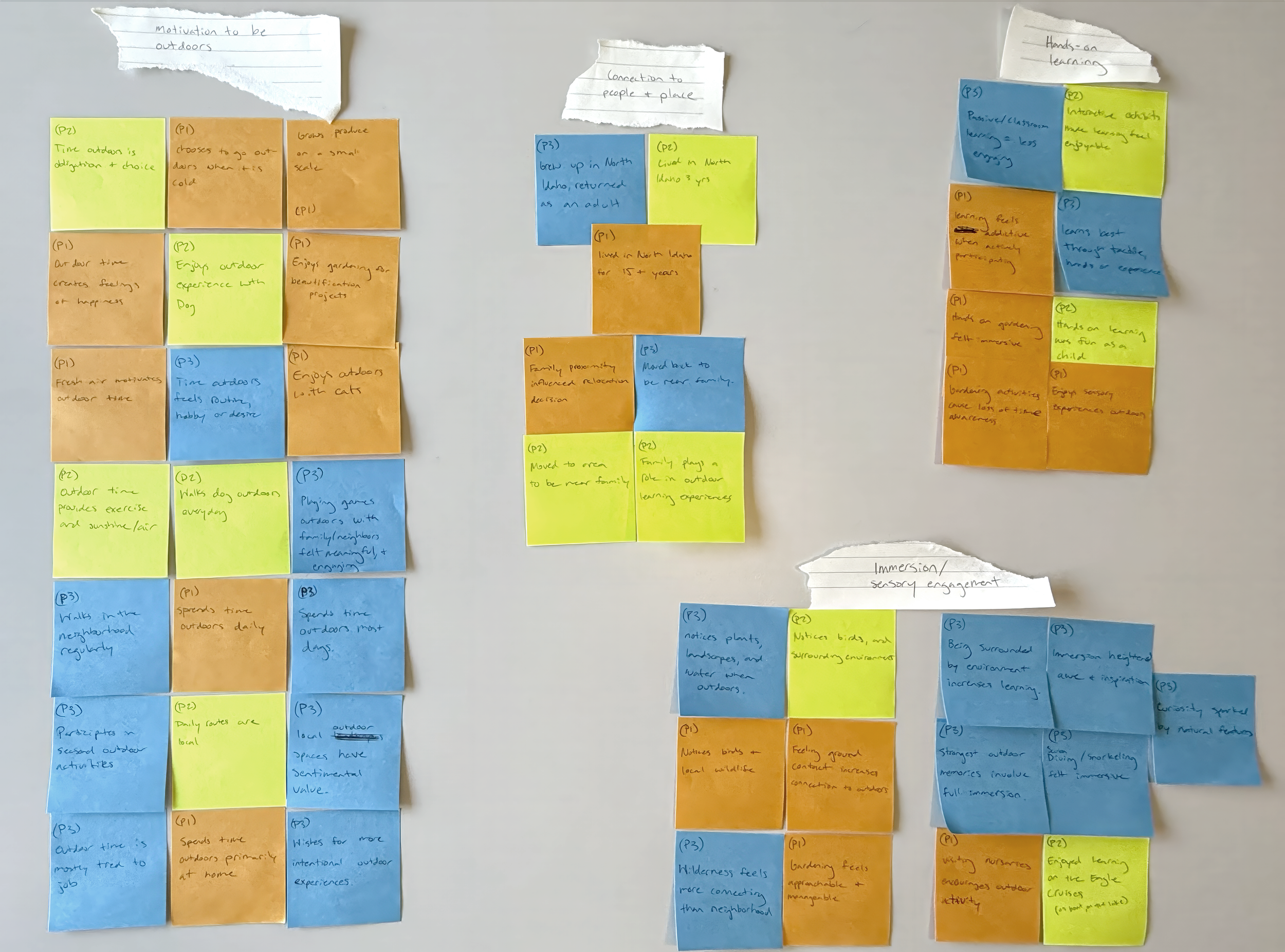
I interviewed participants about their relationships with nature, learning, and memorable experiences. Affinity mapping revealed five recurring patterns:
Immersive, sensory experiences create deeper learning and emotional impact.
Hands-on participation makes learning more engaging and accessible.
Connection with nature often happens through ordinary, everyday experiences.
Time, weather, and seasonal conditions can limit deeper outdoor engagement.
Familiarity, memory, and local context strengthen people's connection to place.
Together, these findings suggested an opportunity to rethink how people encounter environmental education. The concept brings the immersive and participatory qualities people valued in direct experiences with nature into an accessible learning environment, using the ecology and natural history of the Inland Northwest to create a stronger connection to place.
Concept
The Botanical Education Center was conceived as an immersive, place-based learning destination where visitors could explore the natural systems of the Inland Northwest. Through living landscapes, interactive exhibits, and environmental storytelling, complex ecological processes become tangible, sensory experiences grounded in the local region.
Developing the Experience
I began by considering the visitor journey as a whole, including how someone would arrive, transition into the environment, and gradually move from familiar surroundings into deeper exploration.
The experience begins the moment visitors enter the property, transitioning from a busy public road into a calm, park-like landscape. A garden path leads toward a welcoming house designed to feel more like approaching a neighbor's home than entering a formal institution. Inside, the familiar, human-scaled environment provides space to arrive, orient, and settle into the experience before continuing.
Beyond the welcome house, the landscape gradually becomes wilder and more exploratory. Branching paths allow visitors to follow their curiosity through the gardens, while the shift away from the familiar introduces a growing sense of discovery. One path eventually leads to a set of doors embedded in what appears to be an ordinary hillside.
Inside, visitors begin a gradual descent underground. Daylight remains visible through a skylight above but recedes as they move farther from the surface, while the environment becomes quieter, cooler, and more enclosed. The experience is intentionally unfamiliar without feeling unsafe, creating a threshold between the everyday landscape above and the systems and history that normally remain unseen beneath it.
At the bottom of the descent, the path opens into a quieter underground chamber where visitors can pause and adjust to their surroundings. From there, a narrowing passage leads into The Living Ground, marking the beginning of a larger journey through the geological and ecological processes that shaped the region and continue to support the living landscape above.
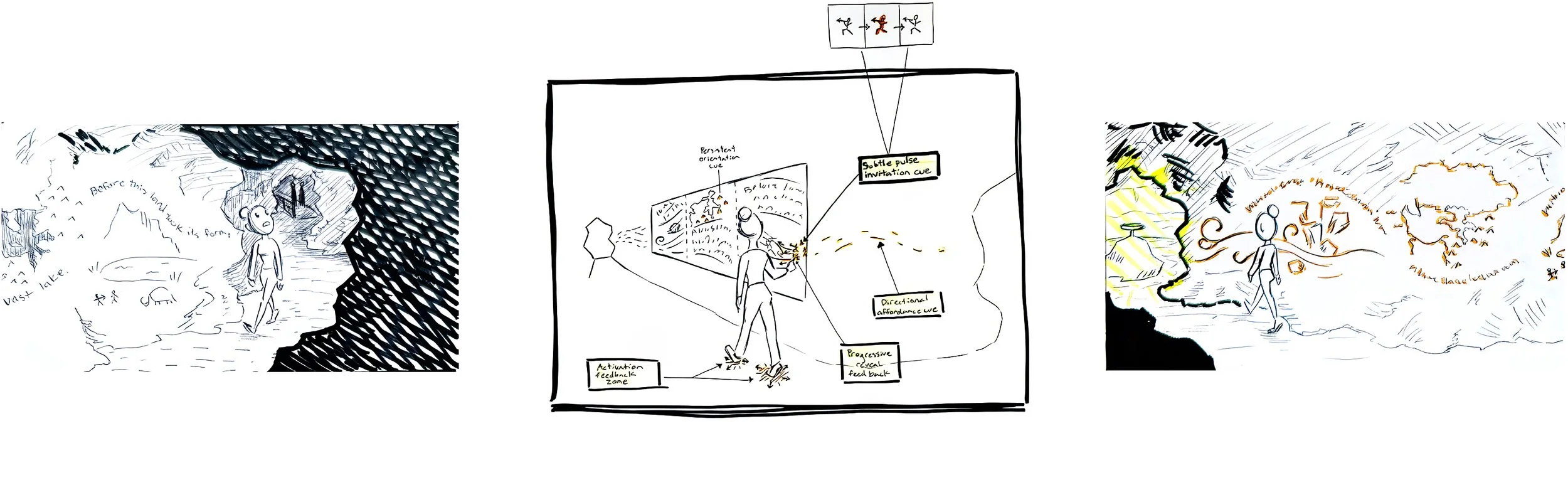
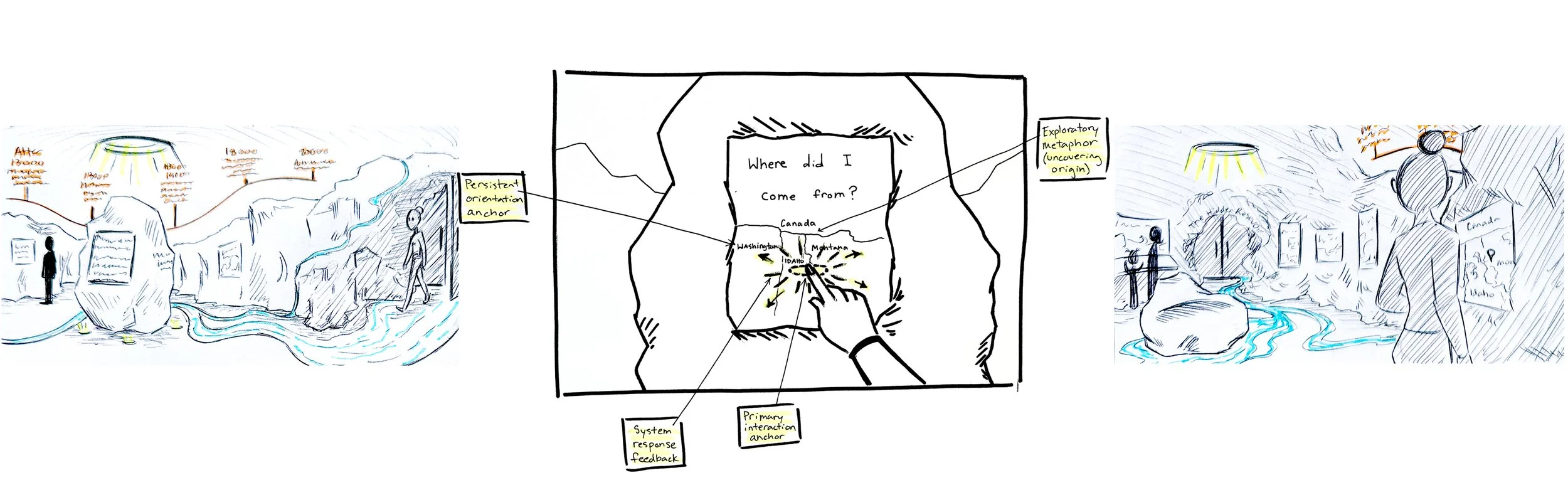
Following the descent, visitors encounter an interactive timeline that begins thousands of years in the past. Through touch and movement, the experience begins to reintroduce the land and its history, providing a new point of orientation after the unfamiliar journey underground and leading visitors toward the events that shaped the landscape above.
Reorientation
Immersion
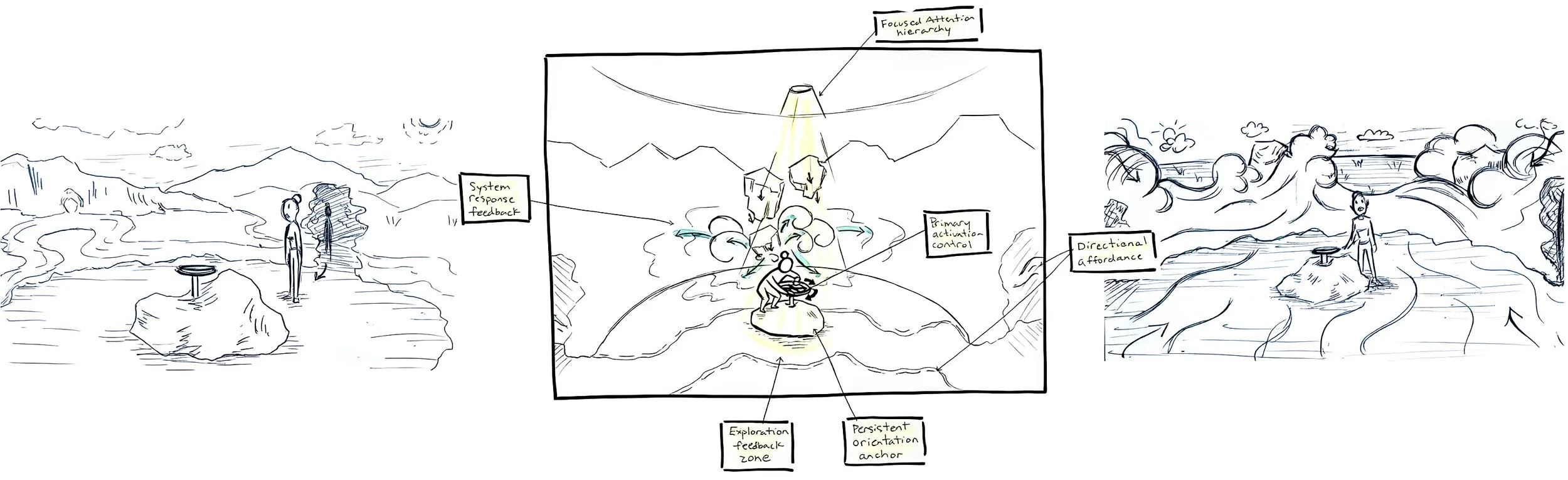
The timeline leads visitors into a circular chamber where the landscape becomes fully immersive. At its center, a large water-valve wheel embedded in stone invites visitors to activate the next stage of the experience. Turning the wheel triggers a multisensory flood sequence as projection, sound, vibration, airflow, and light mist transform the environment from the landscape before the Missoula Floods to the landscape left behind. By physically initiating the change and experiencing it unfold around them, visitors encounter the scale and force of the geological event through direct cause and effect rather than passive observation.
Investigation
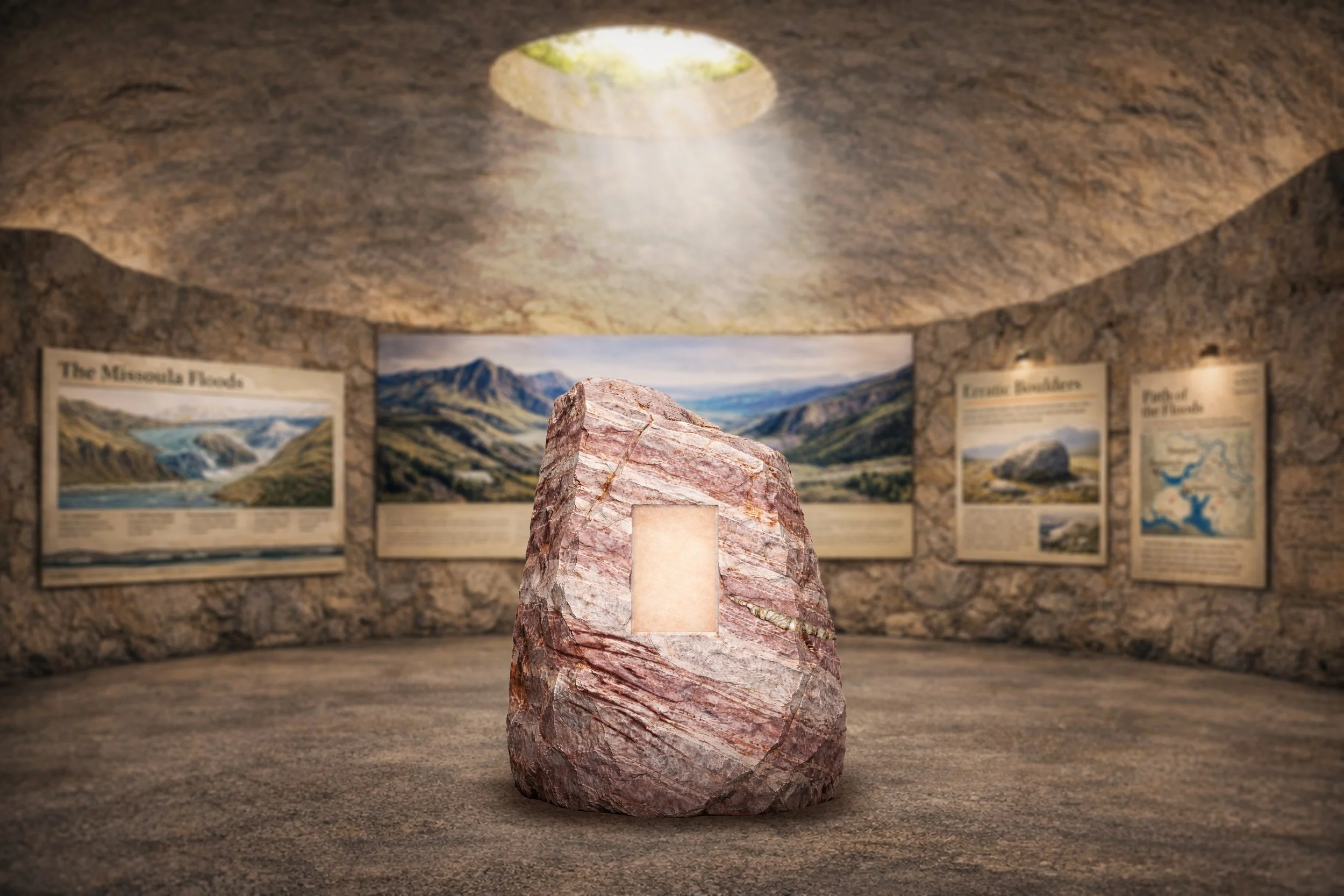
As visitors enter the next space, they encounter a large boulder that appears out of place. As they approach, motion activates a “Tap to Investigate” prompt on its surface, inviting them to uncover clues about how it came to be there. The interaction connects the ancient events experienced earlier in the journey to physical evidence that remains throughout the landscape today.
The following interaction was developed as a prototype to explore how one moment within the larger visitor journey could work in greater detail.
Missoula Floods
Boulder Investigation
Interaction Goal
The boulder investigation was designed as a discovery-based interaction where visitors uncover meaning through physical evidence rather than being given the answer directly. By investigating features on the boulder and collecting clues, visitors gradually build toward identifying it as a glacial erratic and connecting the ancient events experienced earlier in the journey to evidence that remains in the landscape today.
How It Works
Visitors move through a short sequence of interactions that build understanding step by step.
1. Begin the investigation
A subtle prompt invites visitors to start. The interface remains minimal, allowing the physical boulder to remain the focus.
2. Investigate clues
Visitors tap highlighted areas on the boulder to examine physical features, including sedimentary bands, surface scratches, and a quartz vein.
3. Collect evidence
Each interaction reveals a piece of evidence that is added to an evidence checklist, making progress visible and reinforcing understanding.
4. Connect the clues
A second set of evidence deepens the investigation, helping visitors connect clues and move from observation toward interpretation.
5. Interpret the result
With all evidence collected, visitors are guided to interpret it and arrive at the conclusion that the boulder is a glacial erratic.
Testing the Interaction
I tested the prototype to understand whether visitors could recognize how to begin, investigate the boulder without additional instruction, and use the evidence they collected to form an explanation of how it came to be there.
Testing showed that the initial prompt successfully introduced the experience. The main point of friction occurred when the first hotspot appeared. The participant initially attempted to interact with the screen before recognizing the intended interactive area, suggesting that the transition from introduction to physical investigation could be more immediately legible.
The interaction successfully supported inference-based learning. The participant began forming an explanation before reaching the final reveal, indicating that the sequence encouraged active reasoning rather than simply delivering information. However, the transition from collected evidence to the final conclusion felt slightly abrupt and could do more to help visitors connect the clues themselves.
The experience also prompted curiosity beyond the prototype. The participant expressed interest in exploring real-world examples of similar boulders, reinforcing the potential for the interaction to extend into the surrounding region through a map of local glacial erratics.
Next Steps
Strengthen the first hotspot affordance so the shift into physical investigation is immediately understandable.
Add a brief interpretive step that allows visitors to connect the collected evidence before the final reveal.
Extend the experience through a regional map of glacial erratics, connecting the exhibit to evidence visitors can encounter in the landscape.
Reflection
This project explored how immersive environments and interaction could make complex natural systems more tangible and strengthen people's connection to the landscapes around them. The larger Botanical Education Center concept developed around the idea that learning could unfold as a journey, moving from observation to interaction and interpretation rather than presenting information all at once.
The Missoula Floods experience allowed me to develop that approach as a connected visitor journey, while the boulder investigation provided an opportunity to prototype and test one moment in greater detail. Testing showed that the interaction encouraged visitors to form their own explanations from the evidence they encountered and prompted curiosity about the landscape beyond the exhibit.